
The Reassurance Trap: Why Good Medical Results Don’t Cure Health Anxiety
Jun 12, 2026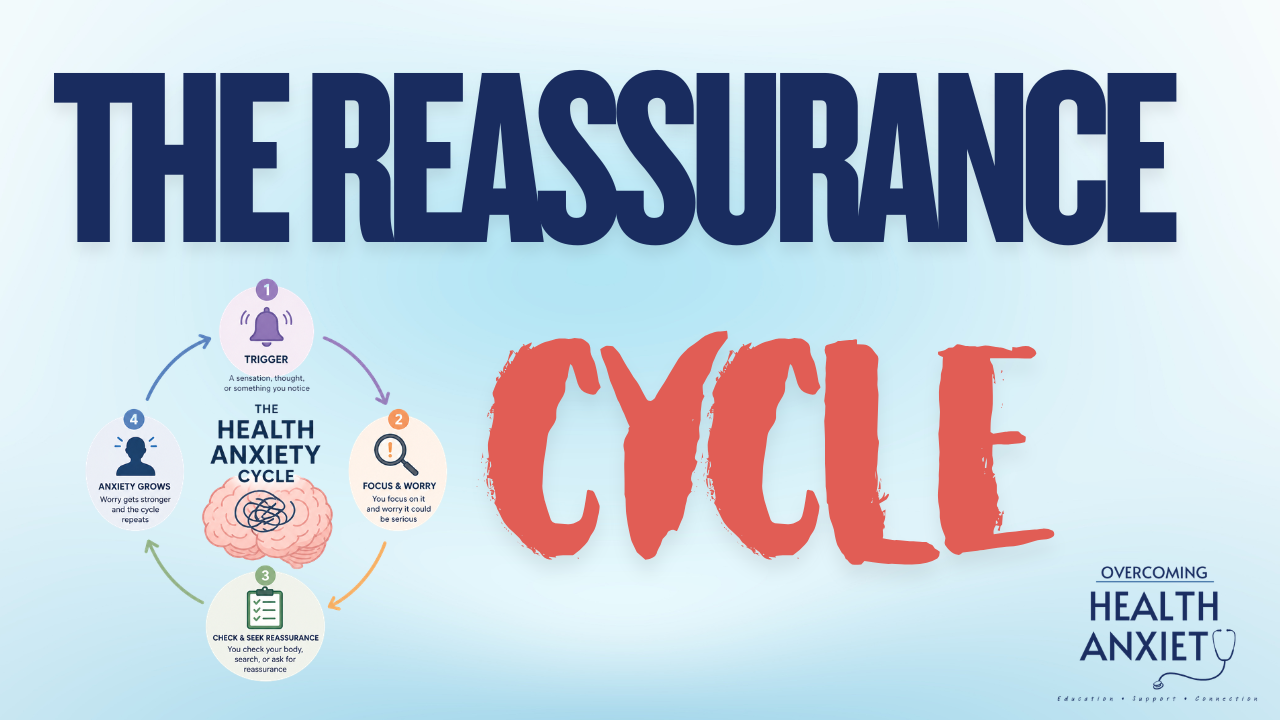
You know the feeling all too well. You spend weeks dreading a doctor's appointment, convincing yourself that the worst-case scenario is true. You finally sit down with your provider, the bloodwork or scans come back completely normal, and the doctor gives you a clean bill of health.
In that exact moment, a massive wave of relief washes over you. You walk out to your car feeling lighter, breathing easier, and believing the nightmare is finally over.
But then, during the drive home, or maybe later that evening, a quiet whisper creeps in: "What if the doctor missed something?" or "What if the lab tech switched the vials?"
Suddenly, that beautiful feeling of safety vanishes, and you are right back at square one, refreshing your patient portal or searching Google for answers. If you are confused about why anxiety returns so quickly after getting good results, you aren't broken. You are simply caught in the classic cycle of reassurance seeking and doubt.
Why Reassurance Only Works Temporarily
When we get a good medical result, our anxiety drops drastically. It feels incredible, but it is fundamentally a temporary fix. Reassurance reduces anxiety in the short term, but it does absolutely nothing to cure health anxiety in the long term.
In fact, reassurance loses its emotional impact over time due to adaptation. Just like a drug, the more reassurance you seek from doctors, Google, or loved ones, the more you need it just to feel a baseline sense of safety. The anxious brain quickly adapts to the good news, strips away its power, and begins looking for the next "glitch" in the matrix.
The Anxious Brain Seeks Certainty, Not Probability
The core reason reassurance doesn't stick is that health anxiety demands absolute certainty, while medicine operates entirely on probability.
When a trusted doctor says, "You are perfectly healthy," they are telling you that based on the objective data, the probability of a major medical issue is near zero. For a brain without health anxiety, that is more than enough to move on.
But health anxiety cannot tolerate that tiny, fractional margin of "what if." It treats a 99.9% guarantee as a catastrophic failure. Because absolute, 100% certainty about the future is an illusion that no test or doctor can provide, the anxious mind will always manufacture a reason to doubt the conclusion. The problem isn't a lack of information; it’s an inability to sit with the unknown.
The Post-Appointment Spike and the "All Clear" Letdown
It is incredibly common for health anxiety to spike right after appointments end. While you are in the clinic, your focus is external by talking to the doctor, answering questions, and reading their body language.
The moment you leave, your focus turns back inward. You begin body scanning. You might notice a tight chest, a tingling limb, or a pounding heart. Because you just left a doctor who said you were fine, your mind panics at these sensations. It makes a subjective evaluation that if the doctor was right, these feelings shouldn't be happening.
In reality, those feelings are just the objective data points of an exhausted nervous system coming down from a massive adrenaline spike. But instead of seeing them as neutral, the anxiety loop uses them as "proof" that the doctor missed something, replaying medical conversations over and over to find a mistake.
Changing Your Relationship with Uncertainty
Recovery from health anxiety does not mean finding the one test or the one world class specialist who finally "convinces" you that you are safe. True recovery involves changing your completely automatic relationship with uncertainty.
Instead of trying to solve the endless possibilities that your mind creates, the goal is to build up your tolerance for not knowing.
-
Notice the urge to check: When the whisper of doubt tells you to call the clinic again or search a symptom, pause.
-
Label the sensation: Use your neutral vocabulary. Acknowledge that your body is feeling jittery or wobbly from the post appointment adrenaline crash, and let it be there.
-
Refuse the ritual: Recognize that calling for reassurance will only feed the loop and make the next wave of doubt even stronger.
Today, practice leaning into probability. You can trust a reasonable, good answer from a trusted provider while still allowing your mind to feel a little bit of doubt. You don't need a guarantee to live your life. Lay down the search for perfection, drop the rope in the tug of war with "what if," and let your nervous system finally settle.
