Mental Health Community
Assess. Conceptualize. Treat
Evidence based tools for mental health professionals to assess what keeps health fear going, sort through overlap with OCD and panic, and apply CBT, ERP, and ACT with care and confidence.
Health Anxiety 101 for Mental Health Professionals
Health anxiety is more than ordinary worry about being sick. It is a pattern of intense fear and preoccupation about one’s health, bodily sensations, or the possibility of serious illness, and it shapes how people interpret symptoms, tolerate medical uncertainty, and use healthcare.
Health Anxiety in the mental health community can be broken down into three actionable items:
Identify
Know what it looks like in your practice:
- Repeated body checking or symptom searching
- Frequent requests for tests, visits, or reassurance
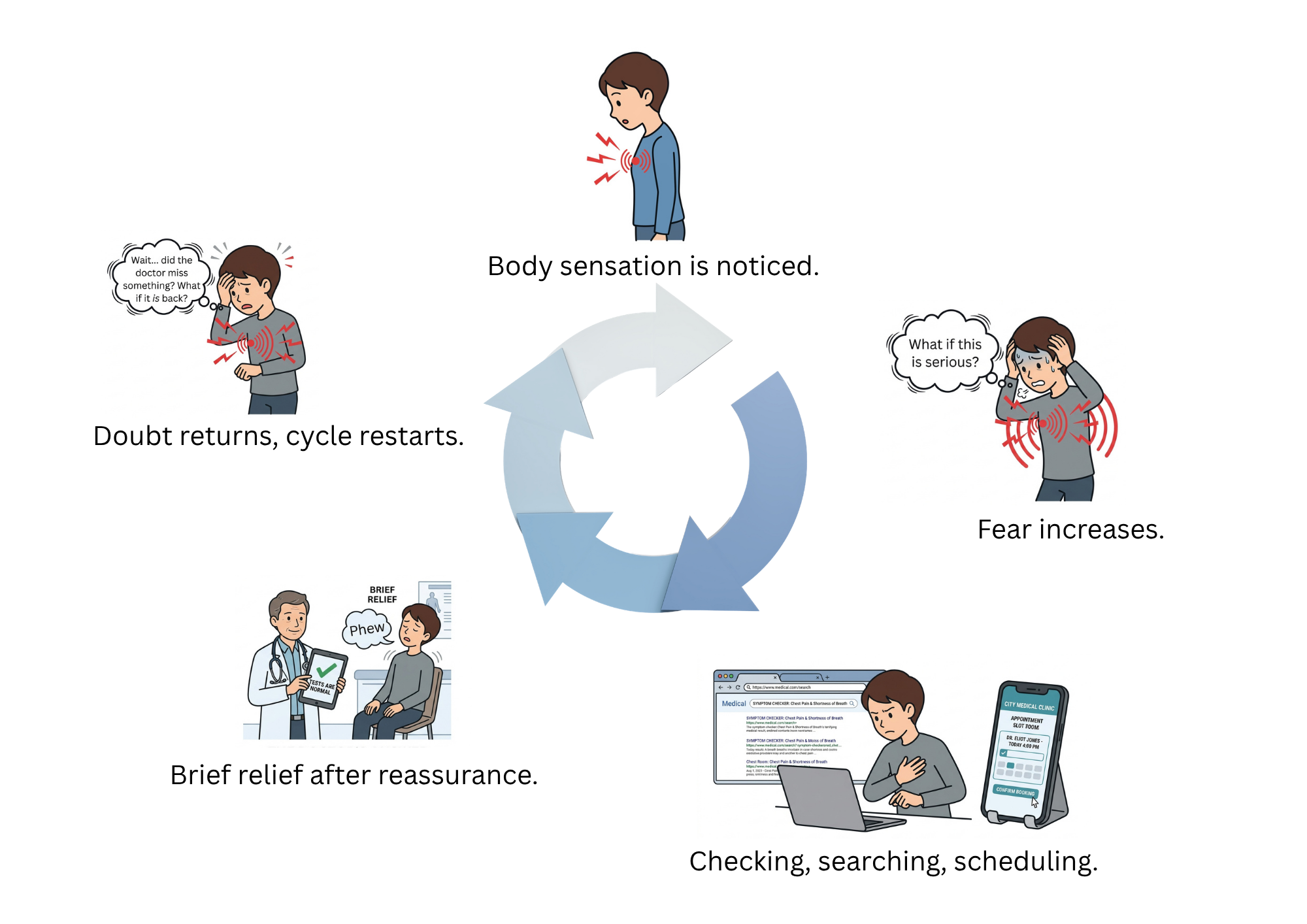
- Relief that fades soon after a normal result
- Avoidance of appointments, screenings, or procedures
- Fear of a missed diagnosis
Educate
Discuss health anxiety without dismissing it:
- Validate that symptoms are real
- Explain the reassurance cycle in plain language
- Set kind, consistent limits on repeat testing
- Keep appropriate medical guidance in place
- Help patients tolerate uncertainty
Refer
Connect patients to care that works:
- Know when a referral is the right next step
- Understand CBT, ERP, and ACT for health anxiety
- Describe treatment in a hopeful, honest way
- Coordinate with the treating therapist
- Support patients who avoid care
A Critical Distinction
Health anxiety is not evidence that a patient’s symptoms are imagined, exaggerated, or medically insignificant. Medical illness and health anxiety can exist together, and good care addresses both without dismissing either.
A mental health epidemic playing out in the medical community.
Health anxiety shows up in primary care, specialty clinics, emergency departments, and therapy offices, often under another name and often unrecognized. These numbers explain why it deserves attention.
~5%
Estimated Adult Prevalence
estimate the baseline prevalence of hypochondriasis / severe health anxiety at roughly 1% to 5% (with broader diagnostic definitions reaching up to ~5–6%).
Citation (1): Weck, Richtberg & Neng (2014)
20%
Screened Positive in Medical Clinics
In a large UK study, 20% of nearly 29,000 medical outpatients screened positive for elevated health anxiety.
Citation (2): Tyrer et al (2017)
41 to 81%
Greater Healthcare Use
Severe health anxiety patients used 41–78% more healthcare annually than a comparison group with defined medical conditions.
Citation (3): Fink, Ørnbøl, & Christensen (2010)
5 Years
Documented Treatment Benefit
In a randomized trial of 444 medical patients, CBT tailored to health anxiety produced benefits that lasted across five years of follow up.
Citation (2): Tyrer et al (2017)
Health anxiety is not a niche issue confined to psychotherapy offices. It deserves recognition in every medical setting.
The Medical Professional's Guide to Health Anxiety
A short, practical reference for physicians, nurses, and advanced practice providers on recognizing health anxiety, talking with patients about lingering fears, and referring with confidence.
- The hallmark features of health anxiety
- Care seeking and care avoidance patterns
- How to respond to repeated reassurance requests
- Overlap with OCD, panic, and medical illness
- When and how to refer
Three ways to connect, one shared passion.
Whether you want to stay informed, bring our team to your organization, or talk through a clinical question, there is a place for you here. Every path leads to the same goal: helping patients and clients move beyond health anxiety with compassionate, evidence based care.
Join for Updates
Receive new guides, research summaries, and training news made for your profession. Choose your topics, unsubscribe any time.
Book us for an Event
Invite our team to speak at your conference, grand rounds, or training program about recognizing and treating health anxiety.
Consult with Us
Talk with us about a clinical question, a care pathway, or a program for your workplace. We will find the right fit together.
References
Weck, F., Richtberg, S., & Neng, J. M. B. (2014). Epidemiology of hypochondriasis and health anxiety: Comparison of different diagnostic criteria. Comprehensive Psychiatry, 55(5), 1137–1145.
Tyrer, P., Salkovskis, P., Tyrer, H., Wang, D., Crawford, M. J., Dupont, S., ... & Barrett, B. (2017). Cognitive–behaviour therapy for health anxiety in medical patients (CHAMP): a randomised controlled trial with outcomes to 5 years. Health Technology Assessment, 21(50), 1–158.
Fink, P., Ørnbøl, E., & Christensen, K. S. (2010). The outcome of health anxiety in primary care: A two-year follow-up study on health care costs and self-rated health. PLoS ONE, 5(3), e9873.